


Podcast Guest

Dr. Wendy Smith

Professor | Author

Guest is known for...

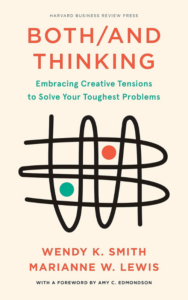
Dr. Wendy Smith is one of the world’s leading scholars on paradox, leadership and organizational change. She is the Dana J. Johnson Professor of Management at the University of Delaware and co-author of the acclaimed book Both/And Thinking. For over two decades, her research has explored how leaders navigate competing priorities, uncertainty and complexity without falling into simplistic either/or thinking.

In this conversation, Wendy explains why many of the toughest challenges in leadership are not problems to be solved but paradoxes to be managed. She distinguishes between tensions, dilemmas and paradoxes, and shows why effective leadership increasingly depends on developing the ability to hold competing ideas simultaneously.

Through stories from her own journey, examples from organizations like LEGO and IBM, and practical leadership frameworks, she explores why leaders often fall into predictable traps such as doubling down on one solution, overcorrecting in the opposite direction or becoming polarized in their thinking.

Published in July 2026

Here's what I will learn...

  • Why leadership becomes increasingly about navigating “right vs right” decisions
  • The difference between tensions, dilemmas and paradoxes
  • Why Either/Or thinking often limits better decisions
  • How Both & thinking unlocks more creative leadership
  • The three forces that make paradoxes more visible: change, scarcity and plurality
  • How leaders fall into Rabbit Holes, Wrecking Balls and Trench Warfare
  • What it means to build paradox fitness over time
  • Why reframing questions is often more powerful than finding answers
  • How to balance exploration and execution without treating them as opposing goals
  • Why living a meaningful life requires embracing interconnected priorities instead of optimizing only one

LISTEN TO THE FULL CONVERSATION

From the Podcast

Wendy Smith speaks about the nuance across these three terms that are often used interchangeably. Tensions are things that pull us in different directions, Dilemmas are daily choices we sometimes have to make and Paradoxes are deeper forces that we need to reconcile.
 • 12m:30s • 
Wendy Smith speaks about how change, scarcity and plurality lead to the paradoxes becoming more apparent.
 • 06m:04s • 
Wendy Smith speaks about how we need to discern the various levels of a paradox and warns us against framing problems / situations as an Either/Or.
 • 06m:42s • 
Just like breath work is often seen as the entry practice for building our capacity for meditation and mindfulness, Wendy Smith invites us to look at how we frame our questions and suggests that as the entry practice to paradox fitness and asks us to focus on making decisions right rather than obsessing over the right decision.
 • 06m:58s • 
Wendy Smith speaks about the paradox between exploring new possibilities and exploiting existing strengths. She explains that while leaders often frame this as an Either/Or choice, enduring success comes from continuously balancing both—doubling down on what works today while simultaneously investing in learning, experimentation and preparing for tomorrow. She argues that the goal is not to divide time equally between the two, but to remain committed to holding both tensions over time.
 • 10m:24s • 
Wendy Smith speaks about 3 common responses to Either / Or problems. Rabbit Holes (going deep into a strategy), Wrecking Balls (over compensating and swinging hard to the other side) and Trench Warfare (not listening to cues from the world and finding reasons to double down on our beliefs)
 • 10m:25s • 
Wendy Smith speaks about how we all can develop a bifocal lens that could help us see the various layers of a paradox.
 • 15m:51s • 
Wendy Smith speaks about two different strategies that we can use to deal with paradoxes. 1) Mule – Doing a combination of things in a way that they take care of multiple priorities. 2) Tightrope – Being
 • 09m:33s • 

Wendy Smith speaks about the nuance across these three terms that are often used interchangeably. Tensions are things that pull us in different directions, Dilemmas are daily choices we sometimes have to make and Paradoxes are deeper forces that we need to reconcile.

Wendy Smith speaks about how change, scarcity and plurality lead to the paradoxes becoming more apparent.

Wendy Smith speaks about how we need to discern the various levels of a paradox and warns us against framing problems / situations as an Either/Or.

Just like breath work is often seen as the entry practice for building our capacity for meditation and mindfulness, Wendy Smith invites us to look at how we frame our questions and suggests that as the entry practice to paradox fitness and asks us to focus on making decisions right rather than obsessing over the right decision.

Wendy Smith speaks about the paradox between exploring new possibilities and exploiting existing strengths. She explains that while leaders often frame this as an Either/Or choice, enduring success comes from continuously balancing both—doubling down on what works today while simultaneously investing in learning, experimentation and preparing for tomorrow. She argues that the goal is not to divide time equally between the two, but to remain committed to holding both tensions over time.

Wendy Smith speaks about 3 common responses to Either / Or problems. Rabbit Holes (going deep into a strategy), Wrecking Balls (over compensating and swinging hard to the other side) and Trench Warfare (not listening to cues from the world and finding reasons to double down on our beliefs)

Wendy Smith speaks about how we all can develop a bifocal lens that could help us see the various layers of a paradox.

Wendy Smith speaks about two different strategies that we can use to deal with paradoxes. 1) Mule – Doing a combination of things in a way that they take care of multiple priorities. 2) Tightrope – Being

Scroll to Top
short_description
known_for
what_will_you_learn
themes
title
Guests
title
description
transcript
guest_name
Nuggets
title
description
Themes